Get in Touch

We’re here to help! Reach out with any questions you may have.

Contact Us Form
Edit Template

Single Events

Which is Better, RO or UV? A Complete Guide to Choosing the Right Water Purifier

Approx. 5-minute read | May 14, 2026
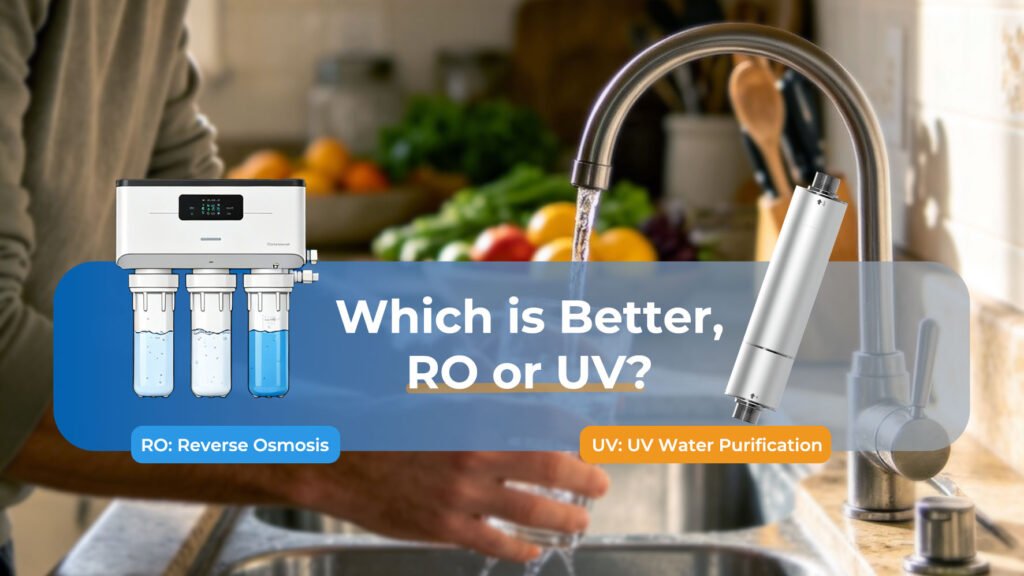
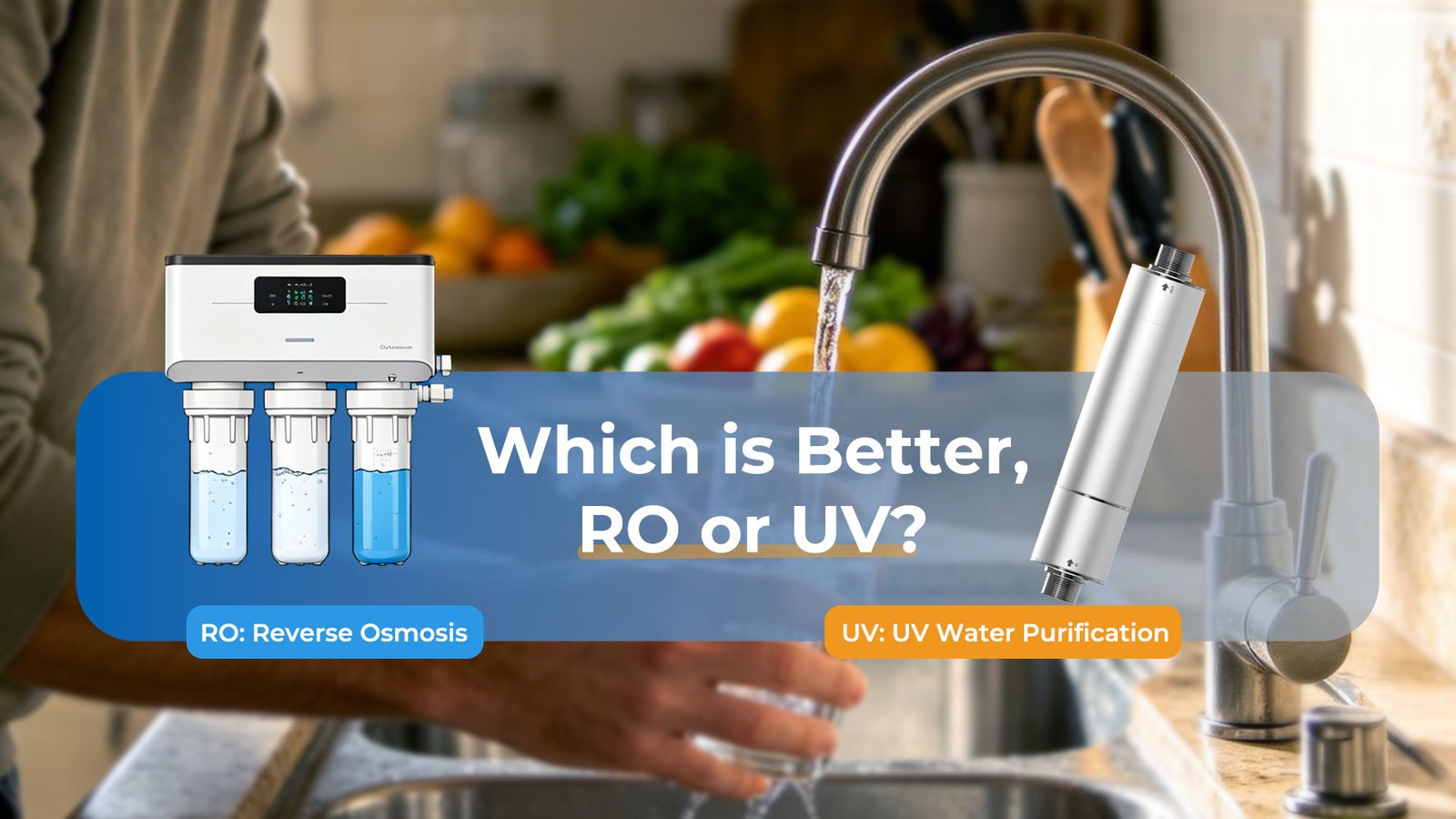
When it comes to ensuring safe drinking water for your family, two acronyms dominate the market: RO (Reverse Osmosis) and UV (Ultraviolet). But which one is actually better for your home? The truth is, there isn’t a single “best” option for everyone. The right choice depends entirely on the quality of your water source and the specific contaminants you need to remove.
In this guide, we’ll break down exactly how each technology works, compare their pros and cons, and help you decide whether you need an RO system, a UV purifier, or a combination of both.
Which-is-Better,-RO-or-UV

💧 What is Reverse Osmosis (RO)?

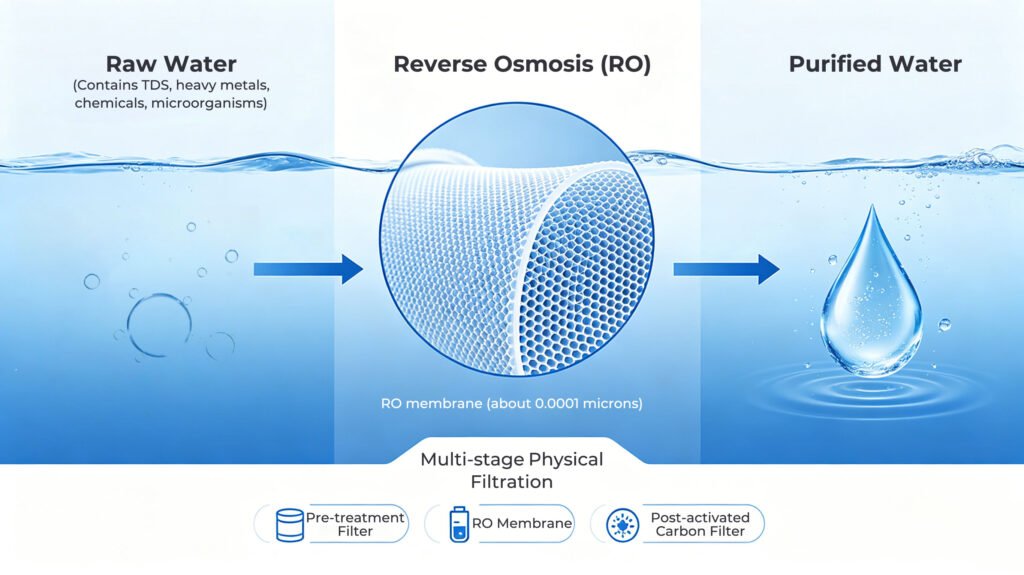
Reverse Osmosis (RO) is a multi-stage physical filtration process. It works by forcing water through a semi-permeable membrane with incredibly tiny pores (about 0.0001 microns).
Think of the RO membrane as an extremely fine sieve. It physically blocks and removes a vast array of impurities, including:
  • Dissolved Solids (TDS): Salts and minerals that make water “hard” or salty.
  • Heavy Metals: Dangerous contaminants like lead, arsenic, mercury, and fluoride.
  • Chemicals: Pesticides, herbicides, and chlorine byproducts.
  • Microorganisms: Bacteria and viruses (due to their size).
Best for: Homes with high TDS levels, brackish water, well water, or water sources suspected of containing heavy metals and chemical pollutants.
What-is-Reverse-Osmosis-(RO)

☀️ What is UV Water Purification?

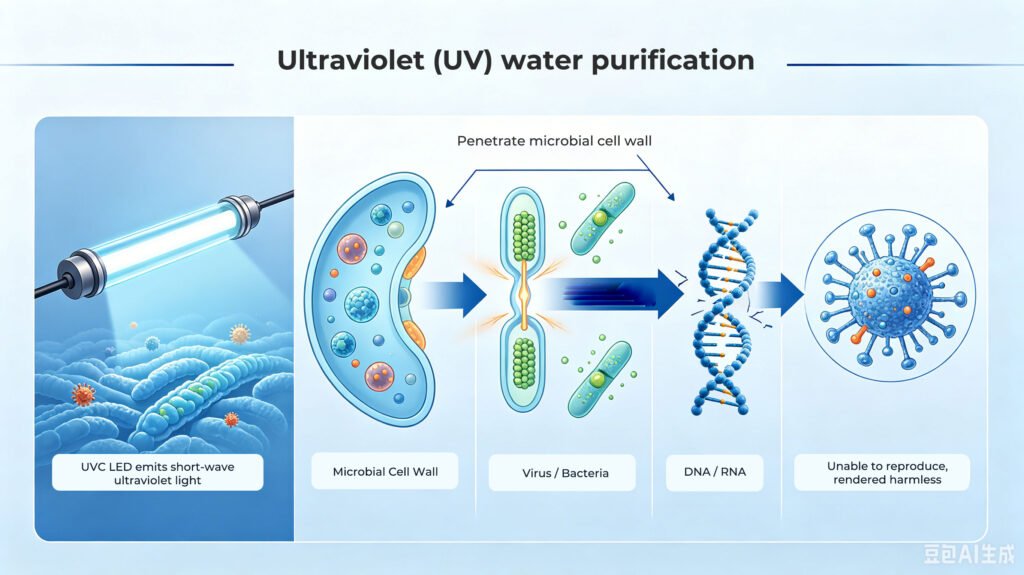
Ultraviolet (UV) water purification is a disinfection process, not a filtration process. It uses a UV lamp to emit short-wave ultraviolet light that penetrates the cell walls of microorganisms.
This light disrupts the DNA of bacteria, viruses, and cysts, rendering them unable to reproduce and making them harmless. However, it’s crucial to understand what UV does not do:
  • It does not remove physical particles, dirt, or sediment.
  • It does not remove dissolved chemicals, salts, or heavy metals.
  • It does not improve the taste or odor of water caused by chemicals.
Best for: Water sources that are already clear and low in TDS (like treated municipal water) but may be at risk of microbial contamination.
Ultraviolet-(UV)-water-purification

⚔️ RO vs. UV: Key Differences at a Glance

To help you visualize the differences, here is a quick comparison of the two technologies:

🤔 So, Which One Should You Choose?

The decision ultimately comes down to one question: What is in your water?
Choose an RO System if:
  • Your water tastes salty, metallic, or “hard.”
  • You live in an area with high TDS (Total Dissolved Solids) levels (generally above 300-500 ppm).
  • You rely on groundwater, borewell water, or tanker water.
  • You are concerned about heavy metals, pesticides, or chemical runoff.
Choose a UV Purifier if:
  • Your water source is municipal supply with low TDS.
  • The water is clear and tastes fine, but you want protection against waterborne diseases.
  • You want a system that does not waste water and retains natural minerals.

🛡️ Why Not Both? The Power of RO + UV

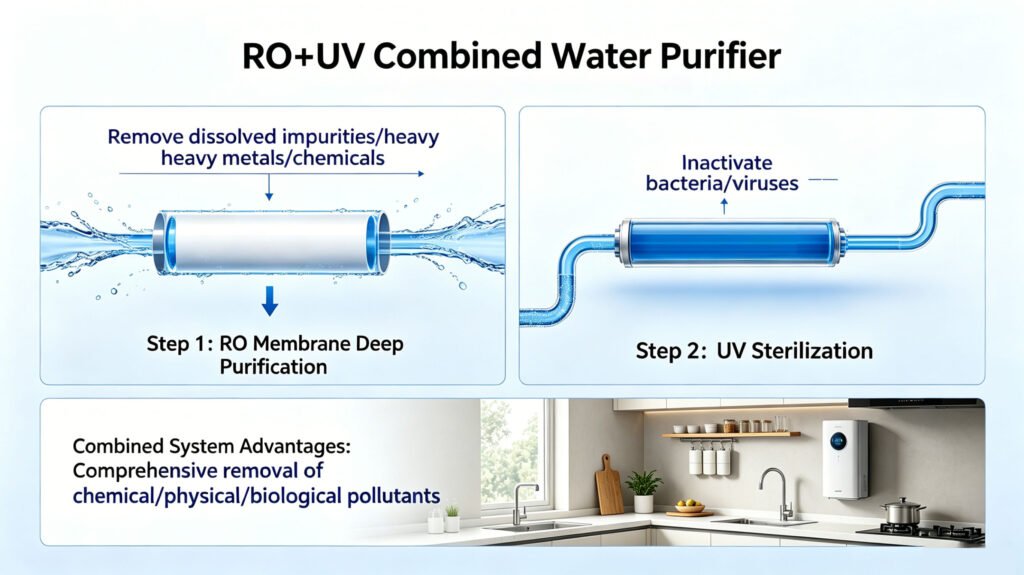
For the highest level of safety, many modern water purifiers combine both technologies. An RO+UV system offers the best of both worlds:
  1. The RO membrane removes dissolved impurities, heavy metals, and chemicals, ensuring the water is pure and tastes great.
  2. The UV lamp acts as a final safety shield, inactivating any bacteria or viruses that might have bypassed the membrane or could potentially grow in the storage tank.
If you want to ensure your water is free from all types of contaminants—chemical, physical, and biological—a combination system is often the most reliable choice for comprehensive family health.
RO+UV

📝 Final Verdict

Neither technology is inherently “better”—they simply serve different purposes.

  • RO is your heavy-duty solution for chemically or physically contaminated water.
  • UV is your targeted shield against biological threats in relatively clean water.
Before investing in a purifier, it is highly recommended to get your tap water tested. Knowing your water’s TDS level and contamination profile is the only way to make an informed decision and ensure you are drinking truly safe, clean water.

❓ Frequently Asked Questions (FAQ)

No, a UV purifier cannot. UV technology is strictly a disinfection method designed to inactivate biological contaminants like bacteria and viruses. It does not filter out physical particles, dissolved salts, heavy metals (like lead or arsenic), or reduce the Total Dissolved Solids (TDS) that cause hard water. If your main concern is chemical contamination or hard water, an RO system is necessary.

Traditional RO systems do produce some wastewater (often called "concentrate") because the membrane needs to be flushed to prevent clogging with trapped impurities. However, technology is advancing rapidly. Many modern RO purifiers now feature high-efficiency membranes and water-saving designs that significantly reduce the wastewater ratio. Additionally, you can easily collect this reject water and reuse it for non-drinking purposes like mopping floors, washing dishes, or watering plants.

Yes, both technologies require electricity. An RO system needs power to run the pump that forces water through the semi-permeable membrane. A UVC LED purifier needs electricity to power the UVC LED beads that emit the germ-killing light. Compared to traditional UV lamps, UVC LEDs are highly energy-efficient, support instant on/off switching without preheating, and typically have a much longer lifespan (over 15,000 hours), making them both eco-friendly and cost-effective in the long run.

Absolutely not. UVC LED sterilization is a scientifically proven, next-generation physical disinfection method. Unlike traditional mercury-vapor UV lamps, UVC LEDs are 100% mercury-free and environmentally safe. They emit a precise deep ultraviolet wavelength (typically 270-280 nm) that is highly effective at destroying the DNA of microorganisms with a sterilization rate of over 99.999%. In a water purifier, the UVC LED module acts as a crucial "final safety shield," instantly activating when you turn on the tap to eliminate any bacteria that might have caused secondary pollution in the pipelines, ensuring the water is sterile right up to the moment you drink it.

Regular maintenance is key to keeping your water safe. Generally, the pre-filters (sediment and carbon) in an RO system should be replaced every 6 to 12 months, depending on your local water quality. The main RO membrane typically lasts between 2 to 3 years. For UVC LED purifiers, the maintenance is remarkably low—thanks to their long lifespan (often exceeding 15,000 hours), UVC LED modules rarely need replacement during the normal life of the appliance, saving you the hassle and cost of annual lamp changes required by traditional UV systems.

Yes, you can, and it's an excellent choice for ultimate safety. You might want to look for a model with a "mineral retention" or "TDS controller" feature. Standard RO filtration is so thorough that it removes beneficial natural minerals along with the harmful contaminants, which can make low-TDS water taste flat. Modern purifiers often include a post-mineralization cartridge to add essential minerals back into the water. Pairing this with UVC LED technology ensures your water is not only mineral-balanced and great-tasting but also 100% free from any bacterial risks.
Category

Tags

Most Recent Posts

  • All Post
  • Academic Papers
  • Blogs
  • News & Events

Most Recent Porducts

Contact Us

Contact Us Form

Pure Water, Powered by Advanced UVC LED Technology

Resource Center

Blogs

FAQS

Support

Product Manual

Subscribe for Partnerships

Be the first to get our R&D updates, case studies, and engineering resources—subscribe now.

Newsletter Form (#4)

 © 2026 INSTAUV LLC. All Rights Reserved. 

Get in Touch

We’re here to help! Reach out with any questions you may have.
Contact Us Form
Edit Template