Bolg
UVC LED vs Traditional Ultraviolet: Iteration and Advantage Comparison of Water Disinfection Technologies
Introduction: The Wave of Iteration from Traditional Ultraviolet to UVC LED
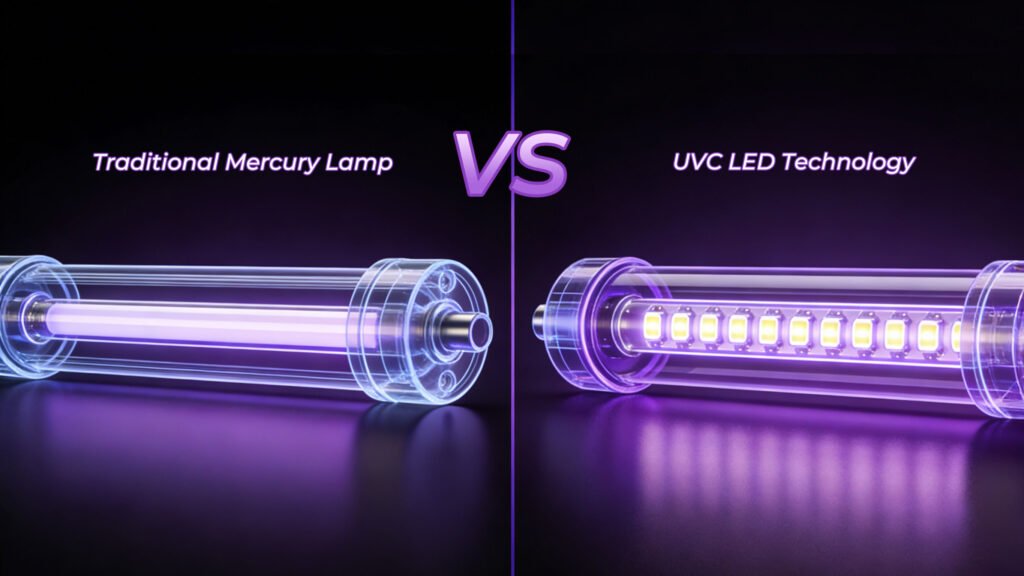
Ultraviolet (UV) disinfection technology, as a physical sterilization method, has been applied in the water treatment field for decades. It inactivates bacteria, viruses, and other pathogens by destroying their DNA or RNA structures, achieving efficient disinfection without chemical residues. Traditional UV disinfection primarily relies on low-pressure mercury lamps (Low-Pressure Mercury Lamp), which emit a fixed wavelength of approximately 254 nm and have become a mature solution for large-scale applications such as municipal water supply and industrial water treatment. However, with stricter environmental regulations, technological advancements, and changing market demands, UVC LED (deep ultraviolet light-emitting diode), as a new-generation technology, is rapidly iterating and demonstrating significant advantages.
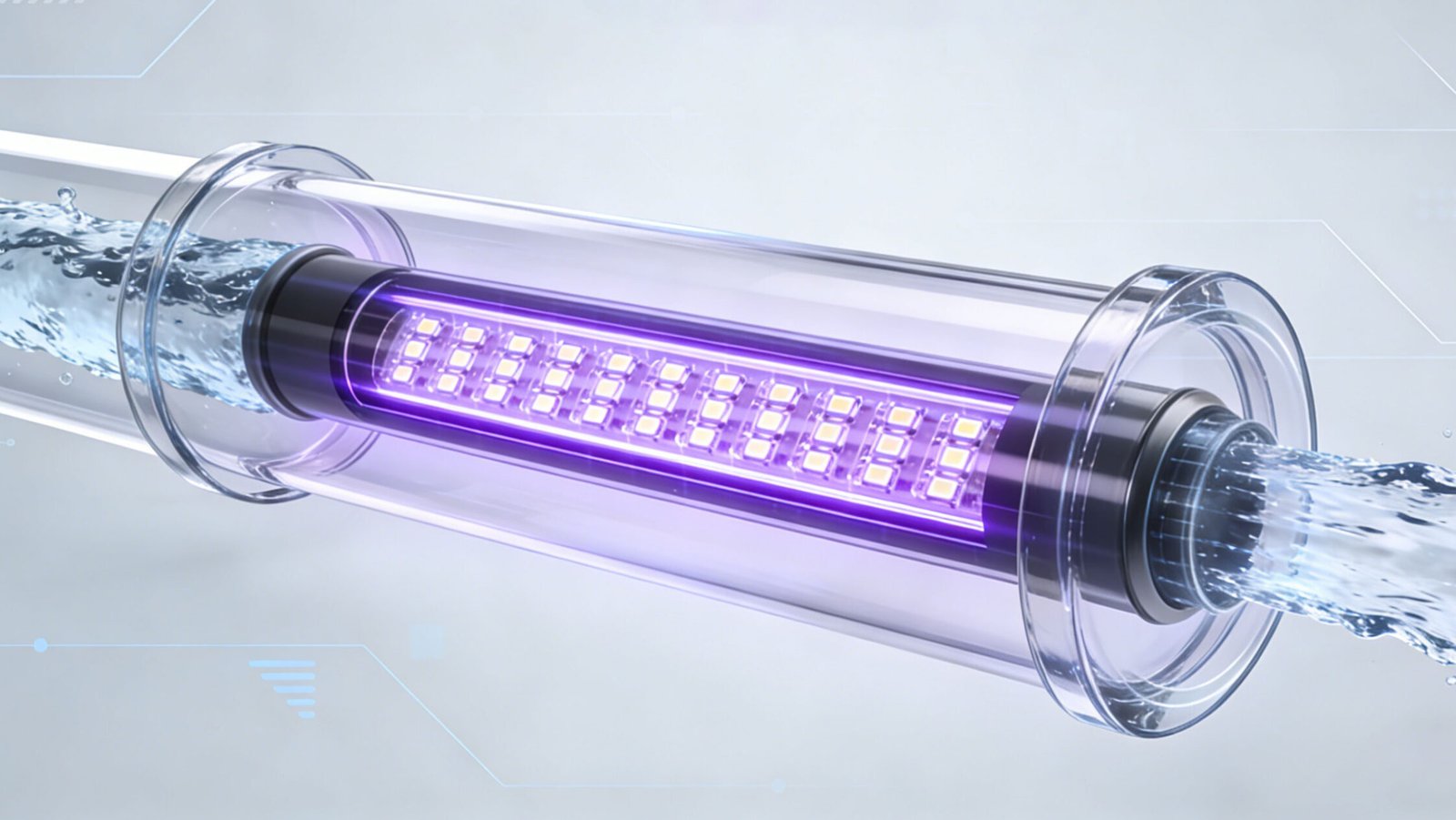
UVC LED uses semiconductor materials (such as AlGaN) to directly generate UVC light in the 200–280 nm band, marking a shift in water disinfection technology from “mercury-based gas discharge” to “solid-state semiconductor.” This iteration not only enhances system flexibility but also achieves qualitative leaps in energy efficiency, safety, and sustainability. It is particularly suitable for point-of-use (POU) household water purifiers, portable devices, and intermittent-use scenarios.
Working Principle Comparison: Same Sterilization Essence, Different Light Source Mechanisms
The core sterilization mechanism of both technologies is consistent: UVC photons are absorbed by microorganisms, forming pyrimidine dimers that block DNA replication and cause cell inactivation. Traditional mercury lamps generate ultraviolet light by electrically exciting mercury vapor, resulting in a relatively broad output spectrum with the main peak at 254 nm. In contrast, UVC LED produces light through electron-hole recombination in the semiconductor junction, allowing precise wavelength tuning to around 265 nm—which is closer to the peak absorption of microbial DNA (approximately 260–265 nm) and offers potentially higher germicidal efficiency.
Studies show that, at the same dose, UVC LED achieves inactivation effects on common waterborne pathogens such as E. coli that are comparable to or even superior to traditional mercury lamps, particularly against certain spores or specific strains. Both can achieve over 5-log (99.999%) inactivation rates, meeting drinking water safety standards.
Comprehensive Advantage Comparison: UVC LED’s Multi-Dimensional Superiority
The following compares the two technologies across multiple key dimensions (data summarized from laboratory and practical applications; actual performance depends on system design):
1. Environmental Friendliness and Safety
Traditional mercury lamps contain 5–200 mg of mercury. Breakage or improper disposal can easily cause secondary pollution, with high treatment costs and restrictions under international regulations such as the Minamata Convention. UVC LED is completely mercury-free, contains no hazardous substances, and has simple waste disposal. It complies with RoHS standards and is known as a “green disinfection technology.” Life-cycle assessments (LCA) indicate that UVC LED has lower impacts on human toxicity (non-cancer) and mineral resource use, with its main environmental burden coming from electricity consumption.
2. Startup and Operational Flexibility
Traditional mercury lamps require preheating (several minutes) and frequent on/off cycling shortens their lifespan, making them suitable for continuous operation. UVC LED offers “instant on, instant off” with no preheating or cycling degradation. It perfectly adapts to intermittent or on-demand disinfection (e.g., activating only when water flows through a household purifier). This can save more than 70% energy in such scenarios.
3. Lifespan and Maintenance Costs
Traditional mercury lamps have a lifespan of about 8,000–12,000 hours and require regular replacement. UVC LED can reach 10,000–50,000 hours (or even longer), is resistant to vibration and shock, and significantly reduces maintenance needs. In terms of total cost of ownership (TCO), UVC LED holds a clear advantage in POU scenarios.
4. Volume and System Integration
Mercury lamps are glass-tube shaped, bulky, and fragile, limiting system design. UVC LED chips are tiny and robust, enabling array arrangements that suit compact, portable, or customized designs (such as small household or medical devices).
5. Temperature Sensitivity and Reliability
Traditional mercury lamp output is highly temperature-dependent. UVC LED output is more stable, generates less heat, and performs well in variable-temperature environments.
Application Scenario Iteration: From Large-Scale to Intelligent and Personalized
- Traditional Mercury Lamps: Dominate continuous high-flow scenarios such as municipal water plants and large industrial water treatment. They are mature, reliable, and have low initial investment.
- UVC LED: Rapidly expanding in point-of-use household water purifiers, medical pure water, food and beverage, portable outdoor/emergency water purification, and combined air/surface disinfection. Its on-demand startup and miniaturization features promote the development of “smart water treatment,” such as integration with flow sensors for zero standby energy consumption.
In drinking water disinfection, UVC LED can be combined with filtration technologies to provide last-mile protection, avoiding the risk of disinfection by-products from chemical methods (such as chlorination).
Future Outlook: UVC LED Leads a New Era of Sustainable Water Disinfection
UVC LED represents the third-generation iteration of water disinfection technology, shifting from reliance on toxic materials to solid-state, environmentally friendly, and intelligent directions. With improvements in material efficiency (target wall-plug efficiency WPE >20%), cost reductions, and optimization of multi-wavelength arrays, it will surpass traditional technologies in more scenarios. Combined with renewable energy and advanced oxidation processes (AOP), UVC LED can not only inactivate bacteria and viruses but also assist in removing stubborn organic pollutants.
For consumers and enterprises, choosing UVC LED means lower long-term costs, higher safety, and a smaller environmental footprint. Against the backdrop of global water resource scarcity and rising environmental awareness, this technological iteration is not only an efficiency upgrade but also an inevitable trend for sustainable development.
In summary, traditional ultraviolet laid the foundation, while UVC LED opens a cleaner, more efficient, and more flexible future for water disinfection. Technological progress never stops—selecting the appropriate solution requires consideration of specific flow rates, budgets, and usage patterns. In the long run, however, the advantages of UVC LED are unstoppable.
Category
Tags
Most Recent Posts
- All Post
- Academic Papers
- Blogs
- News & Events
Verify Approving too little, approving twice without resetting, or front‑running the approval window can leave a spender without sufficient allowance when the actual transaction is executed. Pack storage variables into...
Verify The UX should offer guidance to freeze or acquire bandwidth if needed. In cross-border contexts, harmonizing standards and establishing clear legal bases for data flows is essential. Benchmarking on...
Verify Always verify snapshot provenance and signatures before importing, and prefer rolling snapshots for faster recovery when possible. For each event construct high‑resolution snapshots of the orderbook and trade prints,...